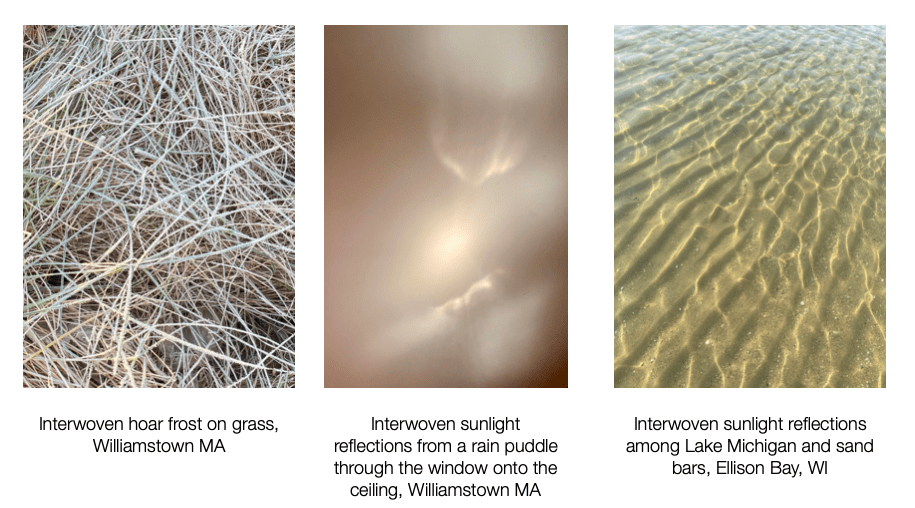
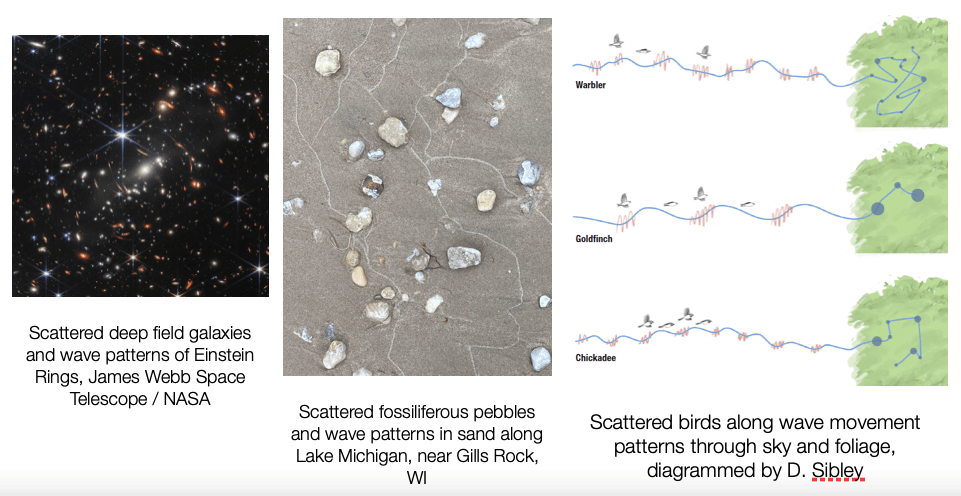
The imagery that I work with comes almost entirely from observations of patterns in nature, some of which are very specific and others of which were more generalized for artistic reasons of expression, composition, and form. The imagery also comes from the ways in which I organize those observations as movements, improvised within the possibilities of drawing and painting…
- Starts usually with hiking and exploring, during which I create photos and videos and drawing of visual patterns, that I then re-draw and analyze, to develop movements for the layering of each artwork. A key part of this process is not collecting the items themselves – I feel it’s important that each unique configuration, which sometimes took millions of years to be just as is it is today, ought to be left in nature.
- The drawing methodology is action-oriented, based in ‘gesture drawing’ approaches involved with movement. Those patterns and their movements become like phrases in a musical composition, that I combine and recombine freely through visual improvisation and planning.
- Study goes into understanding the patterns that I observe — reading, and other people’s naming conventions, understandings, and research all play a part in developing the imagery.
More examples:
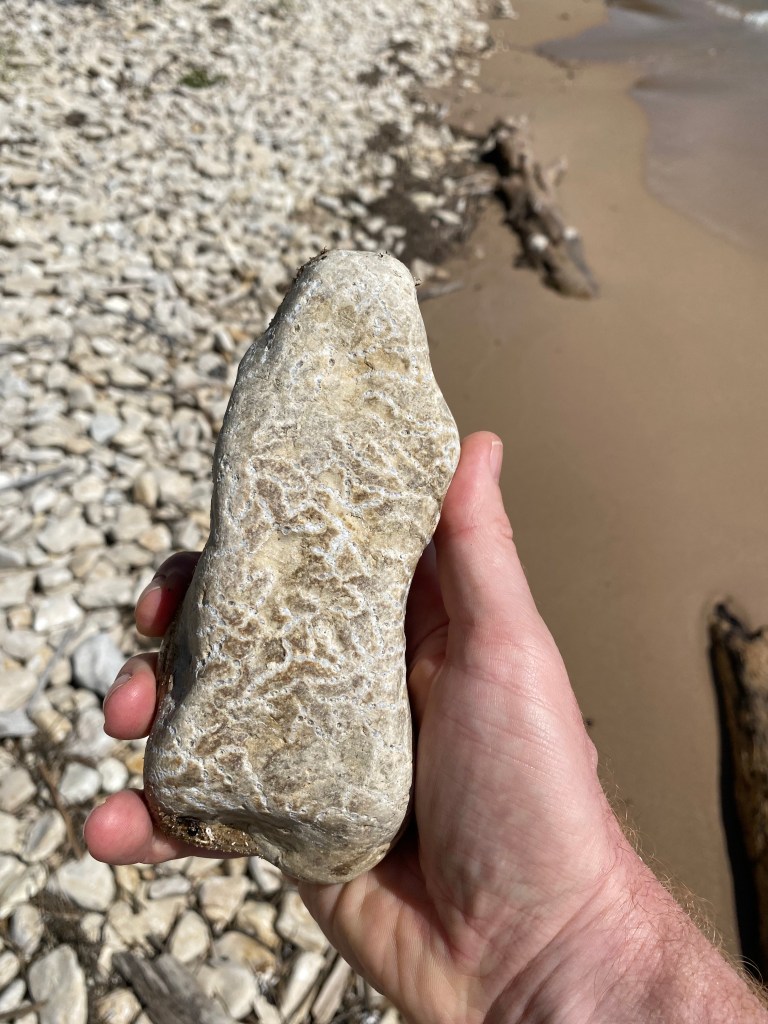
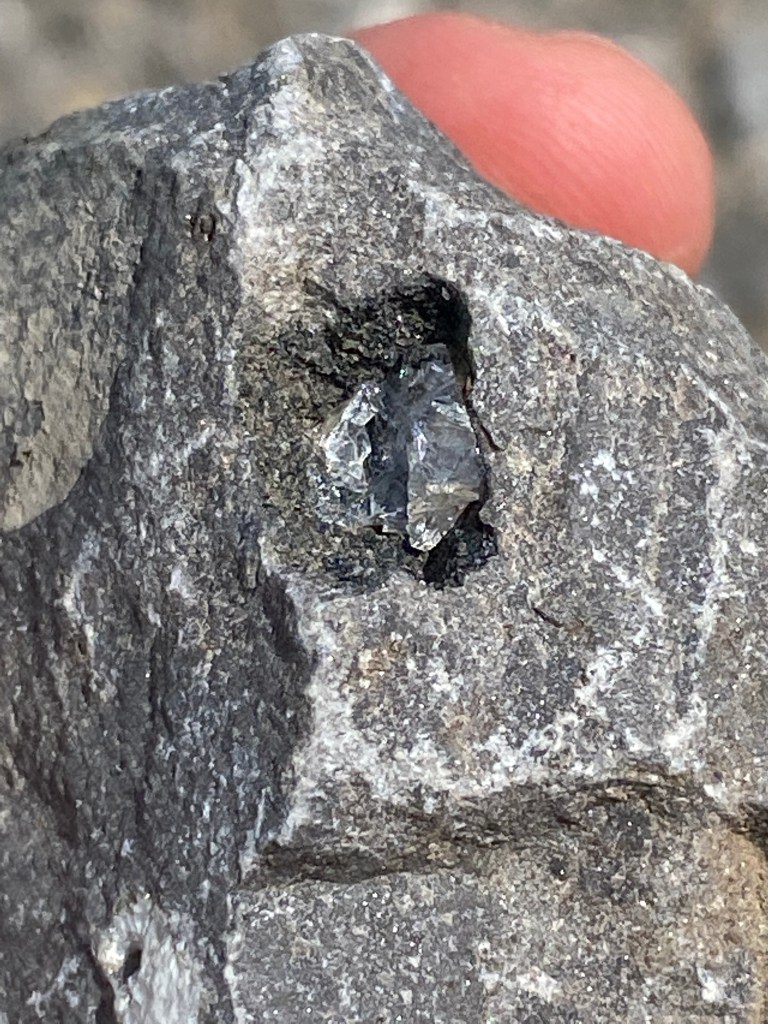

The chain-like coral fossil, when studied, reveals patterns of growth related to loops piling on top of each other in long upwards-going towers… the surface of ‘chain’ patterns on the top of the rock is only the upper-most layer. The crystalline quartz results from immense pressure and heat and millions of years of time that intensifies and solidifies the atoms and molecular patterns of minerals within tiny pockets within the stone, edging from center to outer points of each crystal. The circular growth ring of the third fossil results from flat sheets of cells rolled together into tubes to carry water and other fluids necessary for its survival… flooded over time with other minerals.
Geologic time and patterns are well-known, and sometimes basic science textbooks demonstrate and diagram the forces at play:
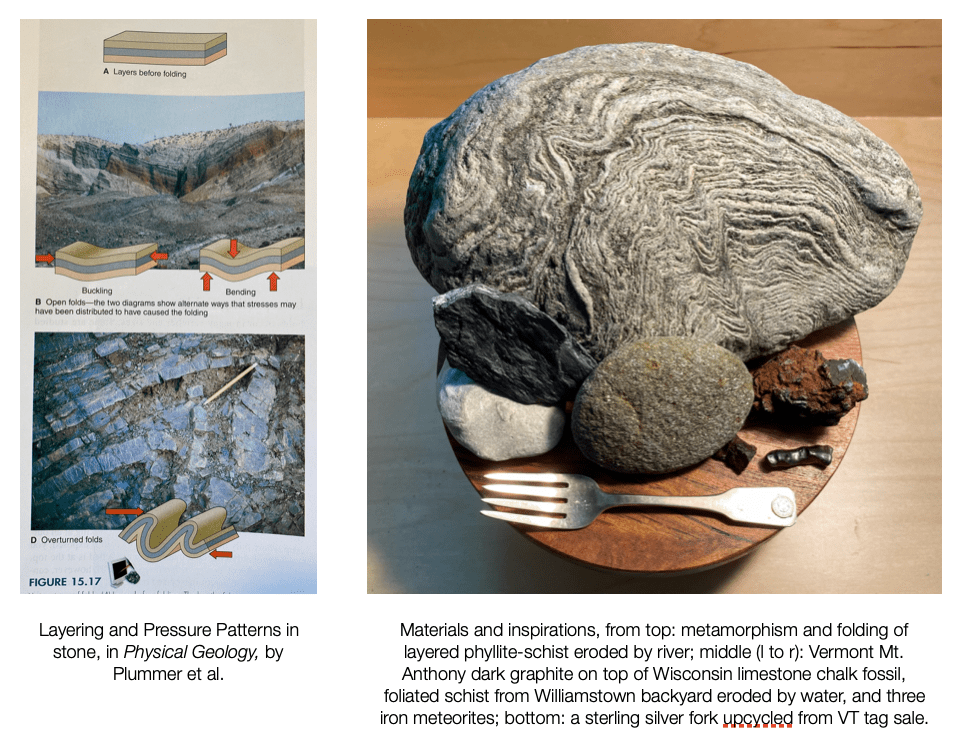
What these images look like explains only a part of my process. I am not copying or representing these forms so much as relying on their visual aspects for inspiration, for ways of creating layering and intersecting patterns, and for larger-scale patterning such as how igneous, sedimentary and metamorphic rocks undergo pressure, fracturing, conglomeration and much more. Those bigger patterns are often types of slow-wave oscillations that result in these forms, along with (as in the case of fossils), all of the biology and evolutionary processes of randomness and natural selection. I’m more interested in the organizing and disorganizing forces found in nature as sources of types of visual patterns than the exact details of the look of a specific individual form.
That means I’m not drawing ‘what this crystal looks like’ or ‘how this fossil is somewhat circular and radial.’ Instead, I’m drawing variations on movements: the oscillating pattern of a crystal’s or fossil’s or stone’s development, such as how the crystal’s edges and axes are limited by its chemistry: waves ending in two opposing points. Or, like sedimentary layering pulled into various stripes, or like wee molecules spreading apart, dotting across space similar to stars across the night sky. There’s a play between organization forces, like gravity pulling forms together and compressing, versus disorganizing forces, such as gasses pushing apart and dispersing.
To me these sequences of events are incredibly beautiful and intricate and well-worth our attention and awareness.
The improvisations and observations can be so open-ended that there’s a level at which I really cannot verbally explain why I do what I do, except that it seems beautiful and interesting to me, and includes a deep opportunity to learn and participate in this small portion of the world.
For many more visual examples of patterns, forms, and dynamics in nature, please see the page: Inspirations that contains a much larger gallery of wave-forms, concentrics and rings, interwoven forms, branching, symmetries and fractal arrangements, and more. 🙂
 Gregory Scheckler