The flexing and forming of marks into lines and tones becomes the art of drawing, which can be divided into several competing types of drawing methods:
- Contour Drawing (outline and inline drawing)
- Gesture Drawing (action-movement drawing)
- Tonal Drawing (shading, illusionism) which is related to ‘Mass drawing’
- Mapping / Schematic Drawing
- Constructive Drawing (line to construct 3-d forms in space)
- Perspective Drawing
Many genres of drawing, such as life drawing from the nude figure, may combine several different methods of drawing into one artwork. So too might the quick, fast sketch combine elements of these methods. Among these many options, Gesture Drawing is focused less on what things look like, and more on how subject matter moves. It is an action-oriented and action-implying way of making marks.
Here is the classic description of the difference between contour drawing and gesture drawing, from the well-known early 20th Century drawing textbook, The Natural Way to Draw, by Kimon Nicolaides:
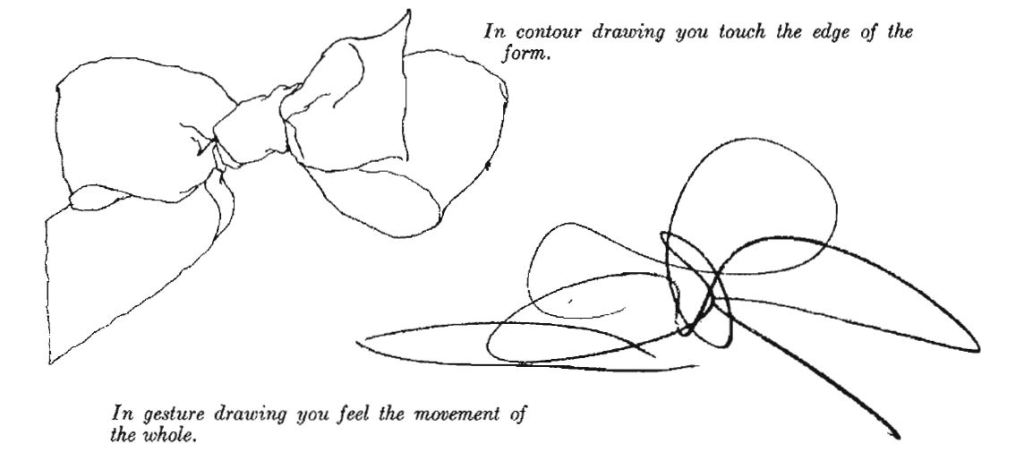
Nicolaiides’ approach develops gesture-drawing in the context of making many quick figure drawing sketches attempting to use line to describe action, movement, weighting, tension and flexing of forms. This is a basis of several types of 20th Century abstraction, notably action painting, as seen in the many sketches by Jackson Pollock, Thomas Hart Benton in their studies of famous paintings. Many other artists amplified these ideas too — Giacometti, Kline, and so on.
Gesture Drawing is the main focus of many of Gregory Scheckler’s artistic explorations. But instead of depicting the human figure through one-minute figure drawing exercises as found in many schools, he’s extended gesture drawing to observations outdoors from nature: trees and plants moving in the wind, geologic formations understood via plate tectonics and erosion and metamorphism, how birds and their flocks tend to move, waves of water on the beach — as these occur in specific combinations of forces in nature, the basis of his artwork is the gestural movements developed out of wave forms, oscillations, feedback loops and similar patterns.
 Gregory Scheckler