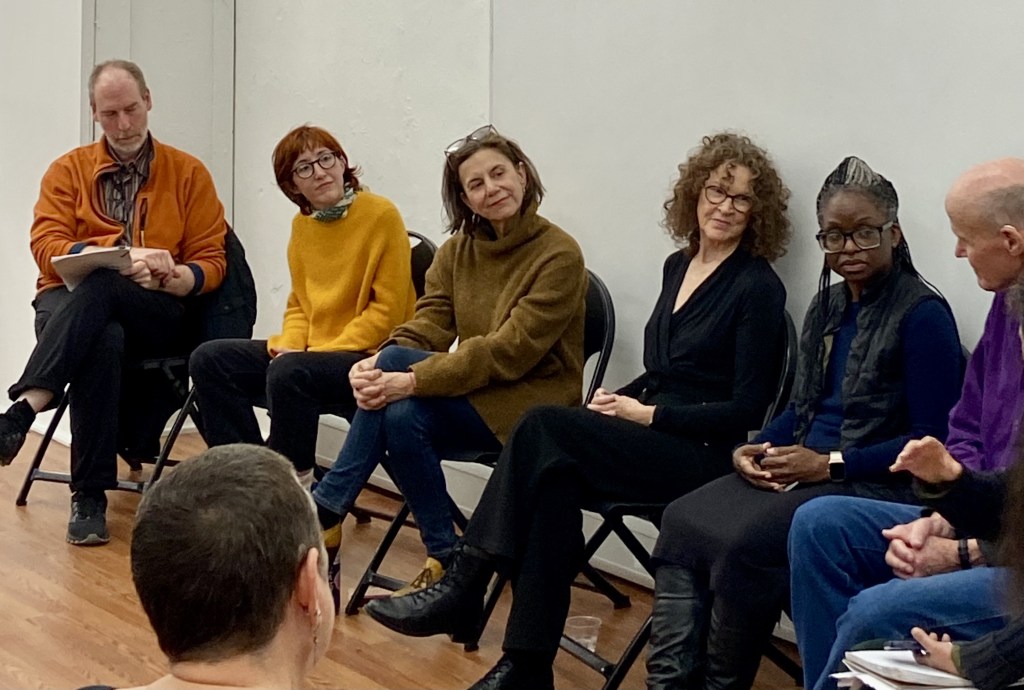
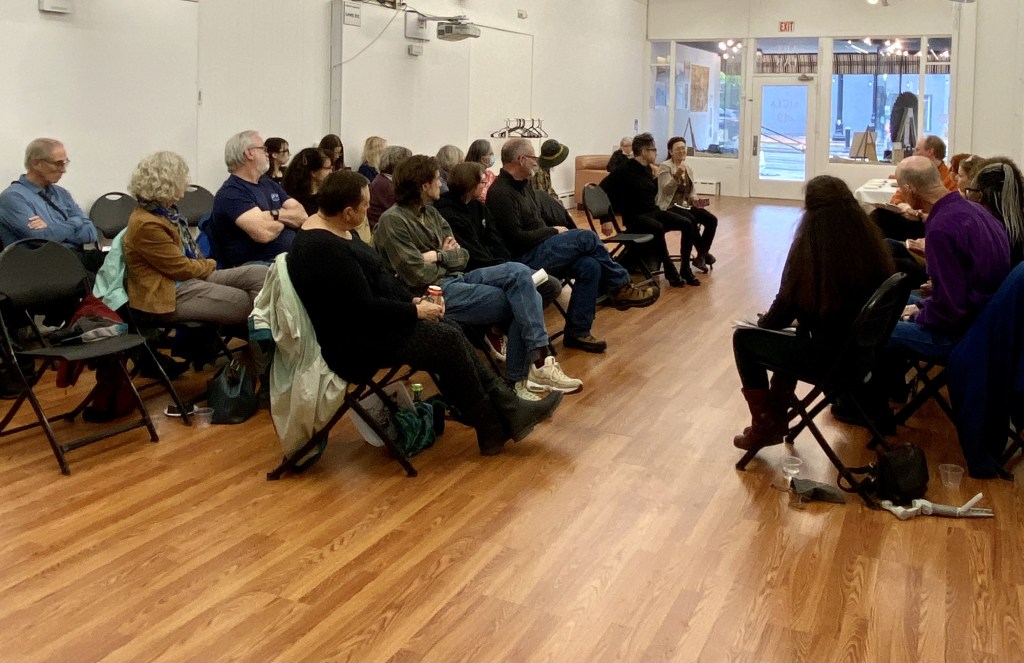
From the exhibit “Reflecting Ecologies” at Gallery 51, 2023. We had a panel discussion featuring all six artists in the show, moderated by journalist-author Kate Abbott.
Notes from G. Scheckler…
Two main points about art and ecology:
- Creativity / Destructivity balance: what are the ecological impacts of making and experiencing artworks? Every artwork’s creation is also an act of destruction: similarly, we metabolize as we live (use fuel, resources, etc.) Unavoidable truths… we destroy as we create.
- Ecology and reducing impact… Think small, a history of doing so: Anyone can make “things bigger and more complex… It takes a touch of genius – and a lot of courage to move in the opposite direction.” E.F. Schumacher, Small is Beautiful (1973: Blond & Briggs) pointing out flaws in production-oriented economies.
- Good ecological news:balancing today’s ecological challenges (pollution, climate change, invasive species, extinction, decay, and entropy) with ecological goodness and successes (beauty, food, community, sustainability, emergence, growth, order). What do contemporary ecosystems provide that is useful and good? One counterbalance here is that ecology, as a science, provides clear, actionable knowledge… we can use our wits, together, to solve environmental problems. Recommended reading: Braiding Sweetgrass, Robin Kimmerer and Fundamentals: Ten Keys to Reality by Frank Wilczak.
- To reduce or not, to minimize/maximize… Aesthetics: what does an artwork look like and how might it be created related to its ecological cost, when it is made from a minimal aesthetic of simplicity, patience, compassion, and balance?
- Change as aesthetics in time… re: the lifespan of an artwork; art in time… : The artwork has a specific lifespan that is also an ecology — is typically less than 100 years — source: “Ars Moriendi: the mortality of art” Gary Schwarz, Art in America 1996.
- Change is inevitable, persistent, normal, real. How long should an artwork last? Ought it to be preserved, or should it be temporary on purpose? Why? How long? What for? “We deceive ourselves in claiming that art is an undying repository of memory, that it comes to us intact from the past, and that it is in our power to preserve it for posterity. Every generation sees the decay or destruction of far more art than it conserves.” (Schwarz)
- A cultural-philosophical history of change in time: “One cannot step twice into the same river, nor can one grasp any mortal substance in a stable condition, but it scatters and again gathers; it forms and dissolves, and approaches and departs.” – Heraclitus, c.500 BCE (The Art and Thought of Heraclitus, LI, p. 53, , Charles Kahn translation, Cambridge University Press: 1987) Philosophical naturalism and its monism, in contrast with philosophical idealism and its dualism (e.g. Parmenides, Plato, etc.) Monism-dualism spectrum…
- Recognizing cultural, natural, and ideological influences in art: “Clouds gather visibility, and then disperse into invisibility. All appearances are of the nature of clouds.” (John Berger, Ways of Seeing, 1972 – both a BBC series and a book)
- If time… then art as continua (ongoing processes) as different than art as chimera (still illusions)… contrasting approaches of documentary ethic versus fiction-fantasy make-believe; gesture drawing vs. contour drawing. Examples of art as temporary (fast) change [some types of eco-art, sand painting, etc] versus art as long-lasting (slow) change: stone carvings, glass that won’t biodegrade for a million years, and so on). Music, dance, movement — the choreography of the artist’s working methods —
 Gregory Scheckler